Get mine now
Star Star Star Star

Rated 4.9/5 From 1000+ Reviews

Vitamin D3 K2 4000iu 30 Tablets

Product Image
Product Image
Product Image
Product Image

Vitamin D3 K2 4000iu 30 Tablets

Increase your levels of vitamin D & vitamin K

£9.99
£0.00 £0.00
Star SAVE  £9.99

1. Number Of Tablets

30
You save 100% - £9.99
£0.00 £9.99

Frequently bought with

Get it by
American Express Apple Pay Diners Club Discover Google Pay Maestro Mastercard Shop Pay Union Pay Visa
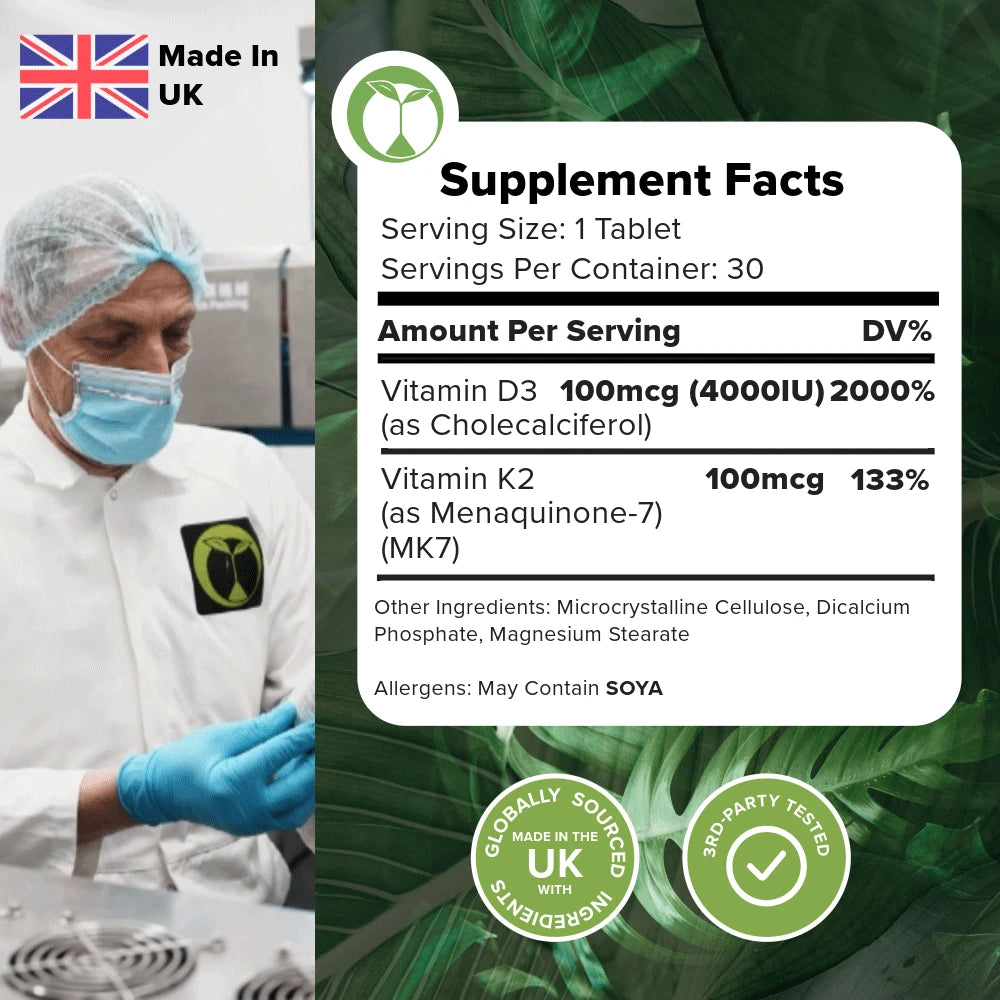
  • Ingredients

Vitamin D3 & K2 is suitable for you if you tick any of these boxes:

  • You want to improve bone health
  • You want to improve your calcium metabolism

Vitamin D3, Vitamin K2 MK7,

Microcrystalline Cellulose (bulking agent),
Dicalcium Phosphate (bulking agent),

Magnesium Stearate (Anti-caking agent).
ALLERGENS: MAY CONTAIN SOYA

As Seen On

ADEQUATE VITAMIN D LEVELS MAY HAVE PROTECTIVE EFFECTS AGAINST COVID-19, INFLUENZA, DEMENTIA, DIABETES, AUTOIMMUNE DISEASE, MULTIPLE SCLEROSIS, PROSTATE CANCER AND COLON CANCER

Studies have shown high rates of vitamin D deficiency in the UK and USA

COVID-19

Observational studies and clinical trials have found strong associations between vitamin D3 supplementation and reduced COVID-19 infection rates, death rates and symptoms.

Research has indicated that 4000 IU (100 mcg) of vitamin D3 is needed to attain optimal blood levels of 40-60 ng/mL.

Image

DIABETES

Observational studies have found an association between low levels of vitamin D in the blood and a high risk for developing diabetes. Associations have also been found in clinical trials between vitamin D3 supplementation and a decreased risk of developing diabetes. Research has indicated that vitamin D may help regulate inflammation and the production of insulin in the pancreas.

Image
Star Star Star Star Star

Rated 4.9/5 From 1000+ Reviews

Get mine now
Product ingredients

VITAMIN D3 & VITAMIN K2

Vitamin D and vitamin K play a central, synergistic role in calcium metabolism. Vitamin D helps to increase calcium absorption in the intestines and vitamin K helps to integrate calcium into bones. Taken together, some research has indicated that they may help to improve bone and cardiovascular health.

Vitamin D3

Vitamin D is sometimes called the “sunshine vitamin” because it’s produced in your skin in response to sunlight. Your body produces vitamin D naturally when it’s directly exposed to sunlight. It’s a fat-soluble vitamin and is found primarily in fish.

However, studies have shown that a large proportion of the population in Europe and the USA are deficient in vitamin D. Our tablets provide a convenient way to improve levels of vitamin D in the body.

Vitamin K2

Vitamin K2 is usually obtained from fermented foods and animal products such as meat, cheese and eggs.

Whilst vitamin K deficiencies are rare, research has indicated that vitamin K supplements may have a beneficial effect on bone and cardiovascular health when consumed with vitamin D.

SCIENTIFIC STUDIES ON VITAMIN D

There is a large amount of evidence to suggest that adequate levels of vitamin D in the blood can have a protective effect against COVID-19, dementia, diabetes and autoimmune disease. We have summarised some of the most interesting scientific studies.

Study 1

Study type: 

Retrospective cohort study. This type of observational study in which a group of individuals with a common exposure are compared to another group of individuals using historical records.

Purpose: 

To investigate whether Vitamin D treatment can reduce the associated risk of COVID-19 infection.

Subjects:

- 220,265 American veterans supplemented with vitamin D3 (cholecalciferol or calcifediol) 

- 34,710 supplemented with vitamin D2 (ergocalciferol or doxercalciferol)

- 407,860 untreated patients (control)

Duration:

January 1st 2019 to December 12th 2020 (before and during the pandemic)

Doses:

Dosage options included 20 IU, 40 IU, 100 IU, 125 IU, 200 IU, 250 IU, 400 IU, 500 IU, 800 IU, 1000 IU, 2000 IU, 5000 IU, 8000 IU, and 50,000 IU. 

Source of data:

Veterans Administration Corporate Data Warehouse (CDW) electronic health records between January 1, 2019, and December 31, 2020

Results:

In US veterans, Vitamin D supplementation during the pandemic was associated with a significant 20% and 28% reduction in COVID-19 infection rates for vitamin D3 and vitamin D2, respectively. 

Vitamin D3 was associated with a significant 33% decrease in mortality within 30-days of COVID-19 infection and 25% lower with Vitamin D2. 

Veterans receiving higher cumulative doses and higher average daily doses of Vitamin D had a greater associated reduction in COVID-19 infection rates than veterans receiving lower doses. The 50,000 IU dosage may be especially beneficial.

Based on these results, there would have been approximately 4 million fewer COVID-19 cases and 116,000 deaths avoided in 2020. These values were calculated by applying the estimated 20% average reduction in infection and 33% reduction in death after infection to a total of 19,860,000 cases and 351,999 deaths through 2020. 

The COVID-19 rates were 2.66% among participants treated with vitamin D3 and 3.30% among the untreated participants, The rates of COVID-19 infection followed by death within 30 days were 0.23% among participants treated with vitamin D3 and 0.35% among untreated participants.

Conclusion:

Vitamin D3 could be a helpful tool for reducing the spread of COVID-19 infection and related deaths, particularly as a large proportion of the UK and US population have suboptimal blood levels of vitamin D.

Year:

2022 (November 12th)

Link:

https://doi.org/10.1038/s41598-022-24053-4 

Study 2

Study type: 

Meta-analysis and trial sequential analysis

Authors:

Leading Italian doctors and scientists

Purpose: 

To explain the strength of the association between the protective role of vitamin D supplementation and the risk of death and admission to intensive care units (ICUs) in patients with COVID-19.

Studies analysed:

5 randomised clinical trials that had been published before September 2022

Doses analysed:

5000 IU; 10,000 IU; 21,280 IU; 21,260 IU; 200,000 IU

Results:

The study found a conclusive association between vitamin D administration and a decreased risk of death (0.49) and ICU admission (0.28). This means that vitamin D was associated with 51% better protection against death and 72% better protection against ICU administration. The trial sequential analysis showed that, since the pooling of the studies reached a definite sample size, the positive association is conclusive.

Conclusion:

The results found a definitive association between the protective role of vitamin D and ICU hospitalisation.

Year:

2023 (January 16th)

Link:

https://doi.org/10.3390/ph16010130 

Study 3

Study type: 

Randomised clinical trial

Purpose:

To determine the effects of 5000 IU versus 1000 IU of daily vitamin D3 supplementation on the recovery of symptoms among mild to moderate COVID-19 patients with sub-optimal vitamin D levels.

Dose:

5000 IU or 1000 IU of vitamin D. The study used 1000 IU as the control because it would be unethical to give a placebo to individuals with suboptimal vitamin D levels. 1000 IU is regarded as a standard control.

Participants:

69 men and women

Duration:

90 days

Results:

Among patients with sub-optimal vitamin D status and mild to moderate COVID-19 symptoms, 5000 IU of daily oral vitamin D3 supplementation for 2 weeks was associated with a significantly shorter time to recovery for coughs and loss of taste. 5000 IU of vitamin D resulted in a significant increase in vitamin D levels in the blood, whilst 1000 IU of vitamin D did not.

Year:

2021

Link:

https://doi.org/10.3390/nu13072170 

Study 4

Study type: 

Randomised clinical trial

Purpose:

To evaluate the effect of vitamin D3 treatment on intensive care unit admissions and death rates among Spanish patients hospitalised with COVID-19.

Dose:

21,280 IU (0.532 mg) of oral vitamin D3 (calcifediol) on days 1,3 and 7 and then weekly until discharge or ICU admission. The control group received no vitamin D. All patients also received standard treatments for COVID. 

Participants:

76 Spanish patients hospitalised with COVID-19

Duration:

4 weeks

Results:

Vitamin D administration was associated with significant reductions in the need for ICU treatment of patients requiring hospitalisation due to proven COVID-19. Vitamin D was also associated with reductions in the severity of COVID-19.

Year:

2020

Link:

https://doi.org/10.1016/j.jsbmb.2020.105751 

Study 4

Study type: 

Randomised clinical trial (single-blind)

Purpose:

To evaluate the effect of vitamin D3 on the immune response against COVID-19 in individuals with severe COVID-19 symptoms.

Dose:

10.000 IU of daily vitamin D3 or a control (2000 IU of vitamin D3)

Participants:

85 patients hospitalised with COVID-19

Duration:

8 to 29 days

Results:

Vitamin D3 administration was associated with shorter hospital stays and improvements in the inflammatory and cytotoxic response against COVID-infected cells.

Year:

2022

Link:

https://doi.org/10.1016/j.biopha.2022.112965 

Study 6

Study type: 

Clinical trial (non-randomised)

Purpose:

To evaluate the effect of vitamin D3 treatment on COVID-19–related outcomes

Dose:

21.620 IU on day 1 (532 mcg) and 10.810 IU on days 3, 7, 15, and 30 (266 mcg)

Participants:

838 patients with COVID-19

Study duration:

March to May 2020 

Results:

In patients hospitalised with COVID-19, treatment with vitamin D3 was associated with significantly reduced ICU admission and death.

Year:

Published in 2021

Link:

https://doi.org/10.1210/clinem/dgab405 

Study 1

Study type: 

Systematic review & meta-analysis

Purpose: 

To evaluate whether administration of vitamin D decreases risk for diabetes among people with prediabetes.

Studies analysed:

3 randomised clinical trials 

Doses analysed:

20 000 IU (500 mcg) weekly; cholecalciferol, 4000 IU (100 mcg) daily; or eldecalcitol, 0.75 mcg daily, versus matching placebos. 

Results:

Vitamin D reduced risk for diabetes by 15% in adjusted analyses, with a 3-year absolute risk reduction of 3.3%. 

Among participants assigned to the vitamin D group who maintained a blood level of at least 50 ng/mL compared with 20 to 29 ng/mL, vitamin D3 supplementation was associated with a reduced risk for diabetes by 76%, with a 3-year absolute risk reduction of 18.1%. 

Conclusion:

In adults with prediabetes, vitamin D may be effective at decreasing risk for diabetes.

Year:

2023 

Link:

https://doi.org/10.7326/M22-3018 

Study 1

Study type: 

Cohort study (a group of individuals were observed over a long period of time to evaluate the effects of vitamin D supplementation)

Purpose: 

To evaluate the effects of Vitamin D on the incidence of dementia.

Number of participants:

12,388 participants with average age of 71

Study duration:

10 years

Results:

Vitamin D exposure was associated with 40% lower dementia rates versus no exposure to vitamin D. Participants taking vitamin D had less mild cognitive impairment and less depression. 

2,696 of the 12,388 participants developed dementia. Among these 2,696 participants, 2,017 (74.8%) had no exposure to vitamin D. Thus, the majority of participants who developed dementia did not take any vitamin D. The researchers did not find any difference in effects between vitamin D3 and D2.

Year:

2023

Link:

https://doi.org/10.1002/dad2.12404 

Study 2

Study type: 

Meta-analysis

Purpose: 

To estimate the association between vitamin D deficiency and risk of developing Alzheimer’s disease and dementia.

Studies analysed:

5 observational studies

Results:

The meta-analysis showed that subjects with deficient vitamin D status (with blood levels less than 20 ng/mL) were at increased risk of developing Alzheimer’s disease by 21% compared with those with vitamin D levels greater than 50 nmol/L.

Conclusion:

Vitamin D status may be associated with increased risk of developing Alzheimer’s disease and dementia.

Year:

2015

Link:

https://doi.org/10.1186/s12937-015-0063-7 

Study 1

Study type: 

Randomised clinical trial (double-blind and placebo-controlled)

Purpose:

To investigate whether vitamin D and marine-derived long chain omega 3 fatty acids reduce the risk of autoimmune disease.

Dose:

- 2000 IU (50 mcg) per day of vitamin D per day or matched placebo, 

- 1000 mg/day omega 3 fatty acids or matched placebo. 

Participants:

There were 25 871 participants (12 786 men ≥ 50 years old and 13 085 women ≥ 55 years old).

Duration:

~5 years

Results:

Among the participants who received vitamin D, 123 individuals developed an autoimmune disease compared to 155 individuals in the placebo group (statistically significant). Although omega 3 fatty acid supplementation was associated with a lower rate of autoimmune disease, the results were not statistically significant.

Conclusion:

Vitamin D was associated with a 22% reduction in autoimmune disease (based on a hazard ratio of 0.78).

Year:

2022

Link:

https://doi.org/10.1136/bmj-2021-066452 

OUR SUPPLEMENTS ARE 3RD-PARTY TESTED

To prove the quality of our supplements, we get them tested by 3rd-party laboratories. Most supplement companies do not get the quality of their supplements verified by 3rd-parties. This means their customers have to blindly trust claims of high quality. We’re different.

Our supplements are 3rd-party tested for:

  • Identity, confirming our supplements are authentic
  • Heavy metals, confirming our supplements are among the lowest in heavy metals on the market

SEE WHAT OUR CUSTOMERS ARE SAYING

Customer Reviews

Based on 5 reviews
100%
(5)
0%
(0)
0%
(0)
0%
(0)
0%
(0)
L
Lee Maxted

My go to brand for everything

L
Lee Arnfield
Second to none

Used to take another well know brand. Switched to these and my sleep has improved to where It would have been when I was a child. Love love love this product and I only take two

J
Jacqueline
I didn’t expect these to work, but they DO!

I started taking these about three weeks ago in desperation from lack of sleep. To be honest I wasn’t expecting them to work. Amazingly they do work and my sleep has been much improved. Over the moon with results, thank you

K
Kevin S
High quality supplements from a company that you can trust

I have been a long term customer of nfsupplements. I believe that the Vitamin D3 K2 tablets help keep me healthy and do what they are expected to do. I am confident that any supplements I purchase from this company contain the levels that are stated on the packaging.
Service and communication have always been first class.

C
CATHY DEAN
Important supplement

I’ve always taken these vitamins, I think they are essential. As such I don’t notice any difference but I like to try different brands.